WhatsApp vs POS for Small Restaurants: Which Wins in 2026?
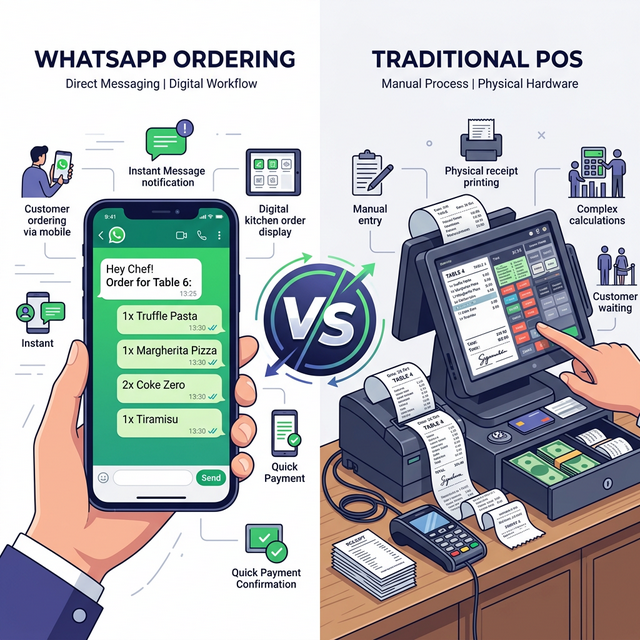
If you're a small restaurant owner trying to figure out how to take orders more efficiently, you've probably been told you need a POS system. But POS systems can cost thousands of rupees upfront, require hardware, and demand ongoing maintenance. Meanwhile, WhatsApp ordering is free, takes 5 minutes to set up, and your customers already have the app.
So which one is actually better for your business? The answer depends on your size, your budget, and how your customers prefer to order. Let's break it down honestly.
What Is a Traditional POS System?
A Point of Sale (POS) system is the hardware and software that restaurants use to process orders and payments. Think of it as a digital cash register on steroids — it handles menu display, order management, payment processing, inventory tracking, and sometimes staff scheduling.
🖥️ What a Typical POS Includes
Popular systems include Toast, Square, Clover, and Lightspeed. They work great for busy, sit-down restaurants with multiple staff and complex menus. But they come with a price tag that many small businesses can't justify.
What Is WhatsApp Ordering?
WhatsApp ordering is a simpler approach: you create a digital menu that customers browse online, then they place orders directly via WhatsApp. Digital menu tools automate this entire process — customers add items to a cart, tap "Order via WhatsApp," and a formatted order arrives in your WhatsApp chat. No POS hardware, no installation, no monthly fees.
💡 In markets like South Asia, MENA, and Latin America, over 90% of customers already use WhatsApp daily. That means zero friction — they're ordering through an app they already know and trust.
The Full Comparison: POS vs WhatsApp Ordering
| Factor | Traditional POS | WhatsApp Ordering |
|---|---|---|
| Upfront cost | Rs. 50,000–300,000+ | Free (Rs. 0) |
| Monthly fees | Rs. 3,000–15,000/mo | Free |
| Setup time | Days to weeks | 5 minutes |
| Technical skills needed | Moderate (training required) | None |
| Hardware required | Terminal, printer, card reader | Just your phone |
| Customer experience | In-store ordering only | Order from anywhere via WhatsApp |
| Inventory management | ✅ Built-in | Manual / basic |
| Online ordering | Requires add-on ($$$) | ✅ Core feature |
| Payment methods | Card, cash, contactless | Cash, bank transfer, mobile wallet |
| Detailed analytics | ✅ Advanced reports | Basic (manual tracking) |
When a POS System Makes Sense
A traditional POS is worth the investment when your restaurant has:
20+ staff members who need role-based access and shift management
Complex inventory with 100+ ingredients that need automated tracking
Multiple locations that need centralized management and reporting
High-volume dine-in with table management and kitchen display needs
Credit card processing as the primary payment method
If you check 3 or more of these boxes, a POS is probably the right call. Systems like Toast, Square, or Lightspeed are solid options — though expect to spend Rs. 100,000+ in the first year between hardware, software, and training.
When WhatsApp Ordering Is the Better Choice
For most small restaurants — especially in markets where WhatsApp is dominant — you don't need a POS at all. WhatsApp ordering is the smarter choice when:
You're a small team — 1–5 people running the kitchen and counter
Your budget is tight — you can't justify Rs. 50,000+ on hardware
Most orders are takeaway or delivery — not dine-in
Your customers pay with cash or mobile wallets (JazzCash, EasyPaisa, STC Pay)
You want online orders immediately — not after weeks of setup
💡 The 80/20 Reality
For a small restaurant, WhatsApp ordering covers 80% of what you actually need: taking orders, communicating with customers, and building a repeat customer base. The other 20% (inventory tracking, staff scheduling, detailed analytics) can be handled with free tools like Google Sheets or a simple notebook — just like millions of small businesses have done for decades.
The Annual Cost Comparison
Let's compare what a small restaurant would spend in the first year with each approach:
| Cost Item | POS System | WhatsApp + digital menu |
|---|---|---|
| Hardware | Rs. 80,000 | Rs. 0 (use your phone) |
| Software license | Rs. 60,000/yr | Rs. 0 |
| Installation & training | Rs. 15,000 | Rs. 0 (self-service) |
| Maintenance & support | Rs. 12,000/yr | Rs. 0 |
| Commission fees | Varies (2–3% per card txn) | 0% |
| Year 1 Total | Rs. 167,000+ | Rs. 0 |
💰 That's Rs. 167,000 in savings in year one alone — money you can invest back into ingredients, marketing, or hiring.
The Smart Hybrid Approach
Here's what we recommend for small restaurants that want the best of both worlds without the POS price tag:
Use a digital menu for orders
Create a free digital menu and receive all orders via WhatsApp. This replaces the order-taking function of a POS — for free.
Track sales in a simple spreadsheet
Use Google Sheets or Excel to log daily sales. This gives you the reporting basics without paying for POS software.
Use WhatsApp Broadcast for marketing
Every customer who orders saves their number in your chat. Build broadcast lists to send weekly specials — 98% open rate, zero cost.
Upgrade to a POS only when you outgrow this
When you're doing 200+ dine-in orders per day with 20+ staff, then invest in a POS. Until then, don't spend money you don't have to.
Frequently Asked Questions
Can WhatsApp ordering really replace a POS system?
For small restaurants focused on takeaway and delivery, yes. WhatsApp ordering handles order-taking, customer communication, and repeat marketing. You'll only need a POS when you scale to high-volume dine-in with complex staff management.
What's the biggest disadvantage of WhatsApp ordering vs POS?
No built-in inventory tracking or advanced analytics. However, most small restaurants track inventory manually anyway, and a simple Google Sheet handles basic sales reporting. The cost savings far outweigh this limitation for businesses doing under 100 orders/day.
How much does a restaurant POS system cost?
Expect Rs. 50,000–300,000 upfront for hardware, plus Rs. 3,000–15,000/month for software. Annual costs typically range from Rs. 100,000 to Rs. 500,000 depending on the system and features you need.
Can I use both a POS and WhatsApp ordering together?
Absolutely. Many growing restaurants use a POS for in-store operations and WhatsApp ordering for online/delivery orders. This hybrid approach lets you capture orders from both channels without paying delivery app commissions.
Start Taking Orders for Free — No POS Required
You don't need to spend Rs. 167,000 on a POS system to take orders professionally. Thousands of small restaurants are using WhatsApp ordering to receive orders, build customer relationships, and grow their business — all without spending a rupee on hardware or software.
OrderViaChat publishes free guides and tools for restaurants and small businesses that take orders directly. Learn how to set up WhatsApp ordering, browse all guides, or try our free tools.