WhatsApp Ordering vs Delivery Apps: 2026 Restaurant Guide
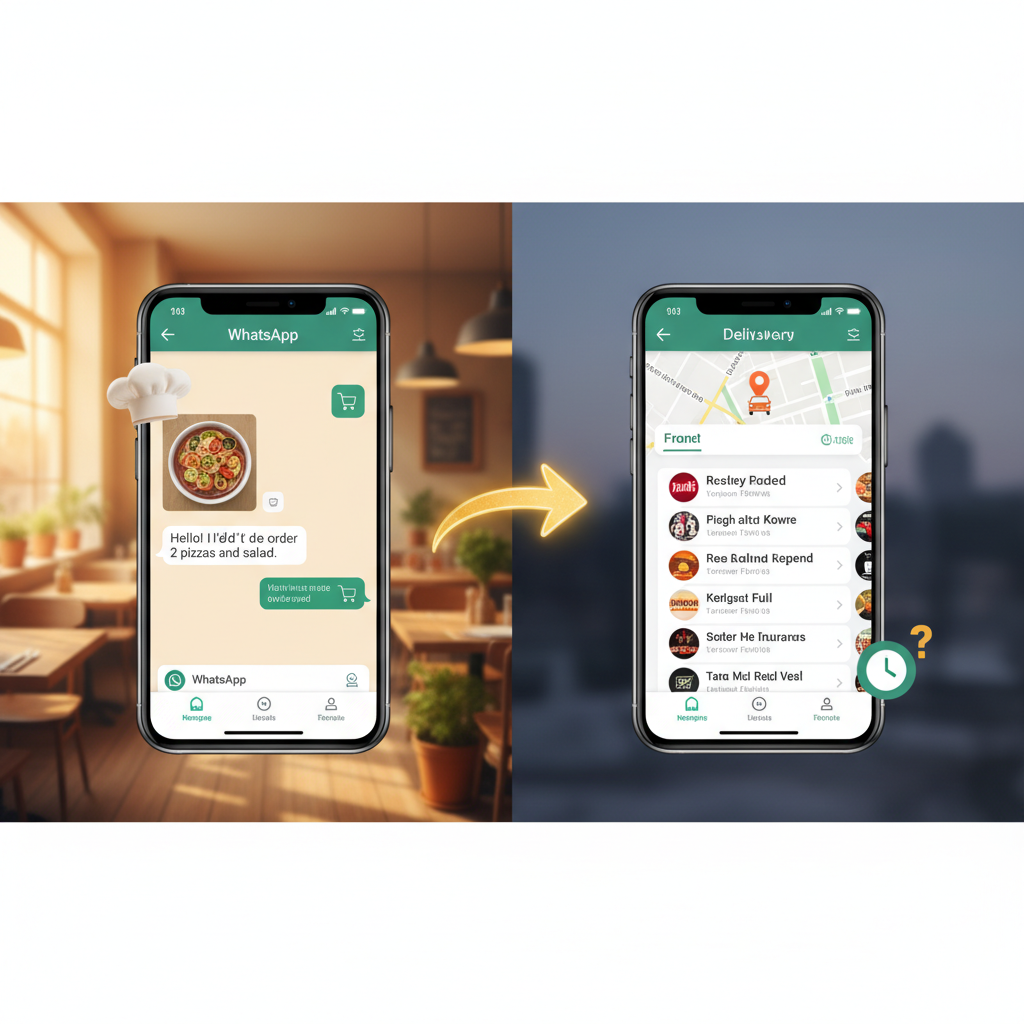
If you're a restaurant owner in 2026, you've probably had this thought: "I'm paying UberEats 30% of every order — is there a better way?" The answer is yes, and it's already on your phone. WhatsApp ordering is quietly becoming the go-to choice for small restaurants that want to keep their profits and their customers.
In this guide, we'll break down the real differences between third-party delivery apps (UberEats, DoorDash, Grubhub) and WhatsApp-based ordering — with hard numbers, the delivery question nobody answers, and what to measure so you know whether the switch is working.
The Head-to-Head Comparison
| Feature | 🍔 Delivery Apps | 💬 WhatsApp Ordering |
|---|---|---|
| Commission per order | 15–30% | 0% |
| Customer data ownership | Platform owns it | You own it |
| Customer relationship | Indirect — via app | Direct — 1-to-1 chat |
| App download required | Yes (customer needs their app) | No — WhatsApp is already installed |
| Delivery riders | Included | Your own rider, a courier, or pickup |
| New-customer discovery | Strong — strangers find you | Weak — only people who know you |
| Menu control | Limited customization | Full control — real-time updates |
| Marketing to past customers | Pay extra for promotion | Free via Status and broadcast lists |
| Branding | Their brand dominates | Your brand, your menu link |
| Setup cost | Onboarding fees + commission | Free on most digital menu tools |
The Commission Problem: Let's Do the Math
Restaurant profit margins are typically in the low single digits. When delivery apps take 25–30% off the top, the math doesn't work. Here's what it looks like over a year:
📊 Annual Cost of Delivery App Commissions
- • 100 orders/month × $25 avg = $2,500/month revenue
- • At 25% commission: $625/month goes to the platform
- • That's $7,500/year — money that could fund a kitchen upgrade, a staff bonus, or better ingredients
Scale that to 300+ orders/month? You're looking at $22,500/year in fees alone.
Run your own figures through the commission calculator — it shows the saving at any direct-order share, not just 100%.
The Delivery Question Nobody Answers
The comparison above hides the one thing delivery apps genuinely do for you: they bring a rider. Go direct and you have three options.
- Pickup only. Zero delivery cost, and a surprising share of regulars are happy to collect if it's cheaper. Most restaurants start here.
- Your own rider. A salaried rider on a motorbike costs a fixed amount per month. Divide that by deliveries: at 12 deliveries a day the per-drop cost is usually a fraction of a 25% commission on an average order. Below roughly 8–10 deliveries a day it is hard to justify full-time; use part-time or evening-only cover.
- Per-drop couriers. Logistics-only services (and increasingly the delivery apps' own "delivery only" products) charge a flat fee per drop without taking a cut of the order. The customer, not the platform, is still yours.
Charge a small delivery fee on direct orders and say so up front. Customers accept a visible Rs. 100 fee far more readily than a hidden 30% built into the menu.
Why Delivery Apps Still Have a Place
Let's be fair — platforms like DoorDash (which holds the majority of the US delivery market) and UberEats aren't all bad. They offer real benefits:
✅ What Delivery Apps Do Well
- • Discovery: New customers who have never heard of you can find your restaurant
- • Logistics: They handle drivers, routing, and delivery tracking
- • Trust: Customers trust the established platform for refunds and support
The key insight? Use delivery apps for acquisition, but move repeat customers to your own channel. That's where WhatsApp ordering becomes your secret weapon.
5 Reasons WhatsApp Ordering Wins for Repeat Business
1. 💰 Zero Commission = More Profit
Every sale is 100% yours. No percentage taken, no hidden fees, no monthly subscription on the free tiers of most digital menu tools.
2. 📱 No App Download Barrier
WhatsApp is on almost every phone in your delivery area already. No friction, no "download our app" requests that most people ignore.
3. 🤝 You Own the Customer Relationship
With delivery apps, the customer belongs to the platform. With WhatsApp, you have their number, you chat directly, and a Status post or broadcast reaches them for free.
4. 🎨 Full Brand Control
Your store, your colors, your logo, your link. Not buried between 50 other restaurants on a scrolling list. Customers visit your menu, not a marketplace.
5. ⚡ Real-Time Menu Updates
Ran out of chicken? Toggle it off in seconds. Running a Friday special? Add it instantly. No waiting for platform approval or dealing with complex dashboards.
Pricing Direct Orders: Don't Copy the App Menu
Many restaurants raise their prices on the apps to absorb commission. That's sensible. The mistake is leaving the same inflated prices on WhatsApp. Three rules:
- Direct prices should be visibly lower than app prices, or match app prices with a free item or free delivery. The customer needs a reason to change habit.
- Quote the full total, including delivery, in the confirmation message. No surprises at the door.
- Keep one menu of record. If you use a digital menu tool, edit prices there and let the app listings follow, not the other way round.
The Smart Strategy: Use Both (But Shift the Balance)
The most successful small restaurants in 2026 use a hybrid approach:
🧠 The Hybrid Ordering Strategy
- 1. Use delivery apps for discovery — Let UberEats/DoorDash bring you new customers
- 2. Include a card in every delivery — "Order direct next time at [your menu link] — save 10%!"
- 3. Move loyal customers to WhatsApp — Share your menu link on Instagram, put a QR code in-store, and add it to your Google Business profile
- 4. Reward direct orders — Offer exclusive deals, loyalty perks, or free delivery for WhatsApp orders
Goal: Get 50% of your orders commission-free within 3 months.
What to Measure (So You Know It's Working)
Track four numbers weekly in a notebook or a spreadsheet. They tell you whether to keep pushing or fix something.
| Metric | How to get it | Healthy sign |
|---|---|---|
| Direct share of orders | WhatsApp orders ÷ all orders | Rising every month; 30–50% by month three |
| Response time | Time from order message to your confirmation | Under 2 minutes during service |
| Repeat rate | Customers with 2+ direct orders ÷ all direct customers | Above 40% after 90 days |
| Average ticket, direct vs app | Total value ÷ orders, per channel | Direct equal or higher (regulars order more) |
How to Get Started in 5 Minutes
Setting up WhatsApp ordering doesn't require technical skills or a big budget. With a digital menu tool, you can:
Create a free digital menu
Most menu tools have a free tier that needs no card.
Add your menu with photos and prices
Some platforms will generate a starter menu from a short description, which you then edit.
Share your link everywhere
Social media, Google profile, printed flyers, QR codes in-store — your menu lives at a shareable URL.
Orders go straight to your WhatsApp
Customers browse, build their cart, and checkout — the full order details land in your WhatsApp instantly.
The Bottom Line
Delivery apps aren't evil — they're great for getting discovered. But paying 25–30% on every order from every customer, including your regulars? That's not a sustainable business model.
WhatsApp ordering lets you keep 100% of your revenue, own your customer relationships, and build a brand that isn't dependent on any platform. The smartest restaurants in 2026 are using both — but shifting the balance toward direct orders every month.
Frequently Asked Questions
Will I lose the customers who found me on the apps?
Not if you keep the listing live. The point is to move repeat orders direct while the app keeps introducing new people. Only remove the listing once most of your volume is already direct.
How do I take payment on WhatsApp orders?
Cash on delivery, bank transfer, or mobile wallets, confirmed with a screenshot in the chat. Ask first-time customers in far areas to pay before dispatch.
Is WhatsApp ordering allowed by the delivery apps' contracts?
Taking orders through your own channels is your business. Some platform agreements restrict what you can put in their packaging or how you price on their listing, so read your contract before printing bag inserts.
OrderViaChat publishes free guides and tools for restaurants and small businesses that take orders directly. Learn how to set up WhatsApp ordering, browse all guides, or try our free tools.